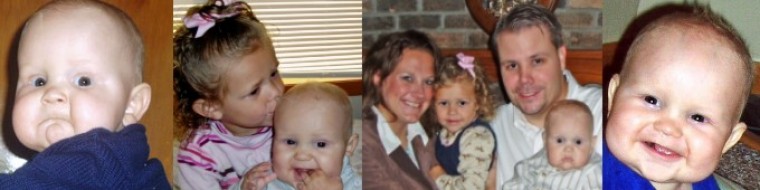
Gavin is on Continuous Cycler-Assisted Peritoneal Dialysis (CCPD) which first became practical and widely used for kidney failure since the 1980’s.
Gavin’s peritoneal dialysis (PD) treatment (which requires sterile technique meaning there is a scrub in time and surgical mask worn during this procedure) is performed every day at home by his parents using a machine called an automated cycler, which performs his exchanges (each cycle of draining and refilling is called an exchange) for ten hours during the night while he sleeps. PD must be performed everyday because fluid must be in his abdomen at all times to clean his blood adequately. Monitoring of his weight and vital signs is also done.
Gavin has a soft tube called a catheter, surgically placed in his abdomen (in the peritoneal cavity) that is used to fill his abdomen with a cleansing liquid called dialysis solution, and also used to carry the dialysis solution out of his abdomen. (Gavin’s catheter has merged with scar tissue created by this surgery and that is how it is kept in place.)
The walls of his abdominal cavity (and yours) are lined with a membrane called the peritoneum which allows waste products, (waste products, such as urea and creatinine, build up in the blood when kidneys fail) and extra fluid to pass from his blood into the dialysis solution the solution contains a sugar called dextrose, salt and other minerals dissolved in water, that pulls wastes and extra fluids from his blood into his abdominal cavity). These wastes and fluids then leave his body when the dialysis is drained, and the used solution, containing these extra fluids and wastes is thrown away.
The period his dialysis solution is in his abdomen is called the dwell time.
Currently, Gavin has ten exchanges a night, for ten hours, with a dwell time of one hour, using the 1.5 and 2.5 liter or combinations of the two, solutions. In the morning his last exchange uses the2.5L solution and his dwell contains 80 cc’s because it must last the entire day.
Sensors will trigger an alarm and shut off his machine if there’s a problem with his inflow or outflow. Because Gavin is drained by gravity, if the alarm goes off (which has happened, sometimes hourly, all night long) Gavin’s parents must come in and wake him up to fix the problem.
Some Complications of Peritoneal Dialysis:
Sometimes CCPD patients may have a solution absorption problem with the daytime exchange because of the long dwell time to remedy this an additional exchange is needed in the mid-afternoon to increase the amount of waste removed and to prevent excessive absorption of fluid (this hasn’t happened to Gavin yet – knock on wood.)
Infection of the peritoneum (peritonitis) abdominal infection – is the most common problem for people like Gavin who are on PD so Gavin’s mom and dad have to wash their hands every time they need to handle his catheter. They must also clean his exit site with antiseptic every day.
Developing diabetes mellitus (requires blood sugar monitoring) or obesity – this develops because of the large glucose (sugar) content of the peritoneal dialysis.
Anemia (low red blood cells) is common to people with kidney disease – Red blood cells (RBC’s) carry oxygen to cells throughout your body. Without oxygen, cells can’t use the energy from food –so- someone with anemia may tire easily and look pale. Anemia also contributes to heart problems.
Anemia is common because failed kidneys cannot produce the hormone erythropoietin (EPO), which stimulates the bone marrow to produce RBC’s. Fewer RBC’s means less oxygen =’s Anemia.
Gavin is anemic and receives EPO injections.
Renal Osteodystrophy (bone disease) affects up to 90% of dialysis patients. It causes bones to become thin, weak or malformed.
Itching (Pruritus) Itching can be made worse by uremic toxins (poisons) in the blood that dialysis doesn’t adequately remove.
Restless Leg Syndrome aching, uncomfortable, jittery or restless legs make kidney patients feel a strong impulse to kick or thrash their legs (theories about this include nerve damage and chemical imbalances.)
Sleeplessness which can lead to “day-night reversal” headache, depression and decreased alertness.
Vitamin and Mineral Deficiency – Gavin has this and receives supplements.
Hernias of the abdomen or groin – Gavin has this.
Hyperkalemia – high blood concentrations of potassium that can cause irregular heart beat and cardiac arrest – this makes diet especially important.
Pericarditis – inflammation of the sac surrounding the heart.
High Acidity of the Blood.
Heart Failure.
Uremic Encephalopathy – abnormal functioning of the brain.
Bleeding from the site where the catheter is inserted or within the abdomen.
Fluid Flow Blockage caused by blood clots.
Abscess formation caused by infections at the catheter site.
Abnormally low blood albumin.
Partial Intestinal Obstruction – caused by development of too much scar tissue within the peritoneum.
Very low thyroid hormone levels.
Hyperlipidemia – (excessive levels of certain fatty compounds in the blood.)
 Save Baby Gavin
Hi, I happened to come by your website by chance, it really did touch me. I am going through a really rough time with my son as well. See I am 34 weeks pregnant and the doctors diagnosed my son with an absent left kidney and a multicystic right kidney. They tell me he might not survive. I’ve been looking for information on treatment options so far everything seems so limited. I am very glad that everything is going well with your family and baby.
Hi I read your story about your baby. We are going through the exact same thing. 1 multicystic kidney and the other one absent. Can you please tell me what the outcome was with your son. I know it was a long time ago. I hope you still come back to this site. I’m 22 weeks pregnant and so worried. My email address is. Salahiss@aol.com. I would be so grateful if you could let me know what happened and if he did survive. Thank you
I am 30 weeks pregnant with twins and they say one of my twins has severe kidney damage in both kidneys along with renal problems. They say that dialysis is extremely hard on the baby and that we may want to consider just letting him die so he doesn’t have to suffer, what do you think?
My boy had kidney failure and was born not being able to breath. After four hours knowing him, he went to be with his grandma and his Maker. I am so thankful that I got to meet him. That is very special to me. Every moment is special, the more you have them, the more you have to treasure about them.
I have a 8 month old daughter she is currently on CCPD she started dialysis a week after birth due to twin to twin tranfussion twin A died in the utero and I want you to know you are in my prayes keep up the good work and thank you for being by your baby’s life its a rough road ahead for renal babies thay get pocked all the time and have so many complications and some parents just can’t take it. Its sad to say but I have seen it here at the hospital all the time. God bless thank you and keep it up
Hi Laura ,
I had exactly the same stuation . Twin to twin sendrom. Unfortunately lost one of the baby and another one had luck of oxygen so it effected both kidney and the brain . My baby on PD since 3 months after birth . It has been years but still hope to get in touch with you if you like
I just came across your website and wanted to let you know that I have a son on CCPD. We found out when he was about a month old that he only had one aplastic kidney (absent right kidney). He has been on peritoneal dialysis for about a month and a half and is doing very well on it. He is just about to hit 7 kg and is 7 months old. He had a rough several weeks after he almost died at 1 month but since then he has been doing well. I wanted to let anyone reading this know that dialysis scared me so much at first but once you start it, it’s not nearly as scary. Machines do go off at all times of the night but really in the grand scheme of things since it is saving my baby’s life, it is well worth it. When I look at his sweet smiling face, all sacrifices are worth it and I am grateful that there is treatment available for his condition.
Thanks so much for sharing everyone. I have a son who is 6 weeks old with one kidney that doesn’t function well. He is on dialysis, still in the NICU but we are trying to muster up the courage to bring him home soon! 🙂 He will transplant at 20 pounds. It would be great to communicate with others who have or had an infant on dialysis. Everyone talks about how rare it is and you feel so alone sometimes. Best wishes to everyone and big prayers for the adorable Gavin. 🙂
Greetings to you! God bless you for this wonderful site. I was blessed to birth boy/girl twins in March. My son was born with multicystic kidneys in both and they had to take them both out. Yes, he died at birth but God said it wasn’t his time so he gave him back to us and he is now 4 months and still in the NICU but he is being put on the machine actually tonight! and will be coming home in a couple of weeks. I must admit I am scared to do this dialysis thing…but If I want my baby to live I must do this! My little girl was perfectly healthy…praise God! But, thank you for sharing your testimony and allowing people to get strength from your story! God Bless you.
I have a cousin 38 weeks pregnant that was just informed that they only see one kidney on ultrasound and they do not think it is functioning well. They told her that if this is true the baby will die soon after birth because dialysis is not an option for a few months. Is this true, or is pd dialysis an earlier option. She is devistated.
My daughter was born with a kidney disease called Polycystic Kidney Disease. This causes multiple cysts to grow and the kidneys become very enlarged. Most babies dont live very long with this disease. Needless to say I had a son who had it also and only lived 10 hours. Thanks to the man above my daughter will be 3 months old on the 17th of Feb. She has been on dialysis since she was 3 weeks old. She had her first kidney taken out at 3 weeks old also. She just had her second kidney taken out about a week and half ago. So she no longer has kidneys. She just had a G tube put in also. Shes doing so good. Shes such a fighter. Shes doing well with her dialysis. Im learning the dialysis machine now to prepare for her to come home. She will be on it at least 16 hours out of the day when she comes home. We have alot of ups and downs but she makes it well worth it. After losing one child already to this disease I’ll do anything to keep her here on earth with me. God is making that happen for us. Its nice to read these replys and see that there is other people out there in the same situation and that Im not alone. I will be praying for all of you. Everyone keep there heaads up and keep fighting for your child. We are the only ones that can fight for them.
My nephew is currently in the picu on an ecmo machine. the drs repaired part of his heart problems but also informed us that a baby his size has a slim chance on surviving dialysis. he is only three weeks old and weighs 4.7 kilos about 10 lbs. reading your stories gives me hope. thank you
Rebecca, with the right care, a 10 pound baby can certainly do peritoneal dialysis. I’m not sure about other issues, but size alone won’t keep him from doing well on dialysis. Our son survived from 4 pounds to 25 pounds, and is preparing for a transplant. Don’t give up!
Does anyone have a website or Facebook I could keep in touch it would be great to chat with other parents who have babies on PD dialysis… my son is 17 months his name is Blake- they truly are superbabies
Sonya, I don’t know about a Facebook page, but our son is 18 months old and preparing for transplant. He’s been on PD since he was a week old. If you have any questions or comments, or would like to chat, e-mail us anytime at reymores @ gmail . com. Hope all is well with Blake, good luck to you!
I have lost 2 to PKD and I have 2 month old with it but doing ok right now her creatine just jumped up to 2 so we are not going to dialysis yet but we are still watching.
Hi all who have asked about connecting with other moms with babies on dialysis/transplant. There is a great group called Kidney Moms on Facebook. Feel free to join. These mamas have been such a support to me. Our little guy is now almost 3 and 14 months post kidney transplant. he was on peritoneal dialysis for 13 months before he got his kidney. I remember feeling so alone and it wasn’t until I found Jill’s site for Gavin that I felt like someone understood.
I was told at my 18th week of pregnancy that our son would not make it and die either before or at birth due to no kidney function (lung development issues). He has three kidneys-2 small ones on one side and a large cystic one on the other side. I had no fluid around him at 30 weeks of pregnancy. I got the shot for his lungs at 28 weeks of pregnancy hoping that would help his chances. My doctor had me wait until my 39th week of pregnancy before he would take him via c-section. Today my son’s lungs are on the small side but they are working on their own without help. He was on breathing machines for his first 5 weeks of life. He has been on PD since he was 4 days old. He would have been on it sooner but he had to be transferred to a different hospital. He is now 7 weeks old and we are almost at full volume for the dialysis. It was a scary thing at first but with God on your side and wonderful nurses and good doctors it is amazing what they can do. We are almost home with our baby boy. Either next week we are getting trained on the PD machine. The key for our out come was faith. Our child never gave up the fight which made me want to fight even more for him. The baby has to fight along side you. It is all up to the baby (+God) and what they want. All I can say is listen to your baby and what they want and have faith because you will need it. Everyday of life is a new day with new issues. But there will be more good days than bad days.
My Son Gage is on CCPD he has been on it since he was three days old and now he is almost three months old. He had a bladder outlet obstruction when he was in utero which damaged his kidneys to NO repair so we have to have a transplant at 20 pounds. They took him at 34 weeks to give him a better chance of making it. I was told by several doctors and nurses that they didn’t see him making it past the first day, he is out to prove them wrong and getting stronger every day. We are still in the nicu but hopefully we will be home soon, his intake is only at 60 and we need to get it to 100 inorder to go on the machine. Every time they get above 60 we start having trouble. I hate it that he has to go thru it but I thank god for him 🙂 To all the mothers that are fixing to go thru any kind of kidney damage, don’t give up there is hope.
Hi I have a 7 month old baby boy whos on Dialysis since he was 4 months old, sad story happen to us. My question for you, my baby when he is on his 12 hrs dialysis and his nigth feeds he attempt to vomit alot,was your baby us too do that to, or any idea why he vomits? I have ask the Dr. but they all give diffrent answer that does’nt make any sence for me
hi just wondering how is ur son my nephew is facing same problem